Add IOP Viewer scripts

New command line tool that generates an HTML page with the graphical view of IOP tests that can be used to visualize tests while testing.

The tool reads the robot code and generate a static page out of it that can be opened directly without the need of a webserver.

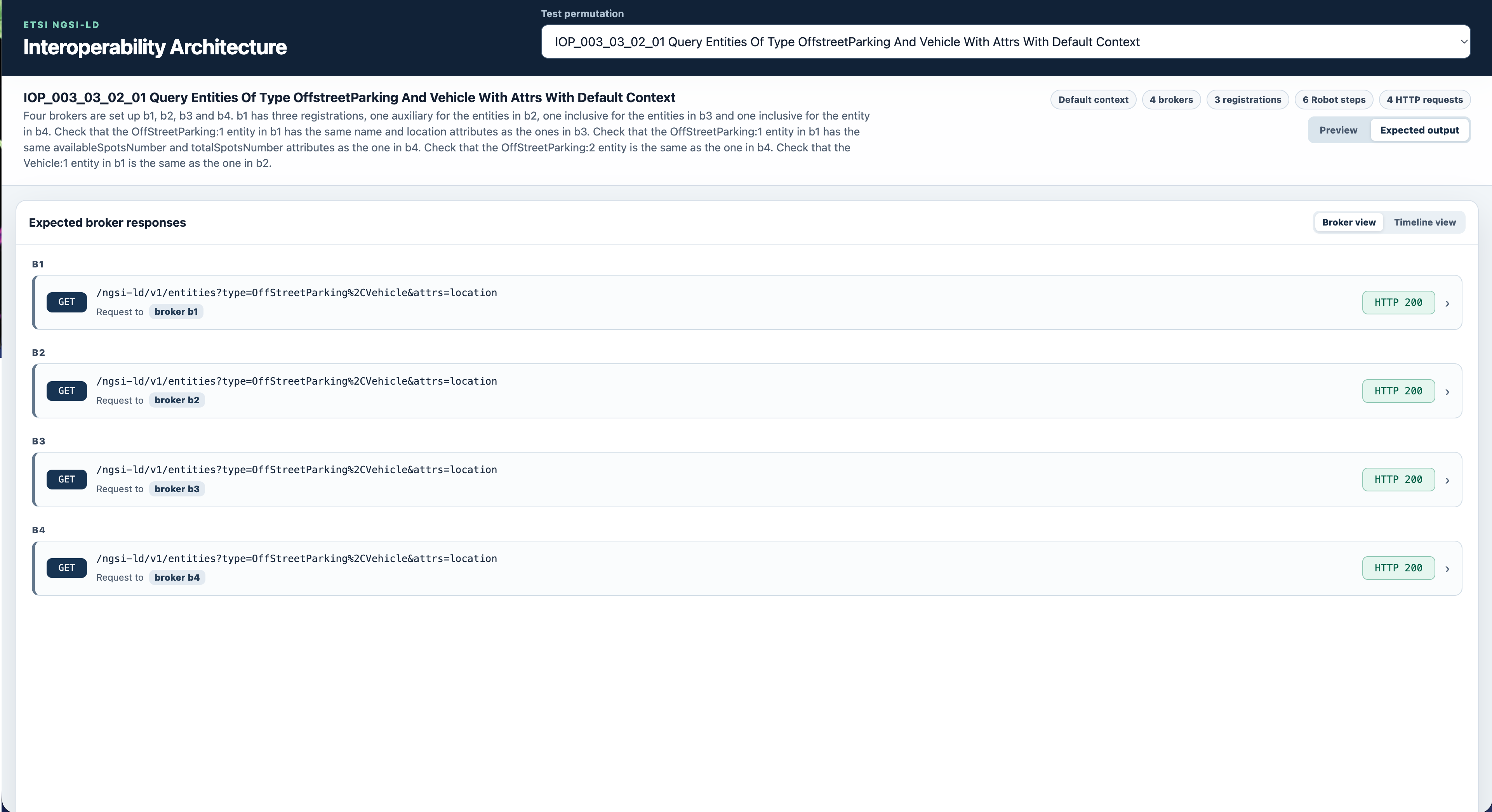
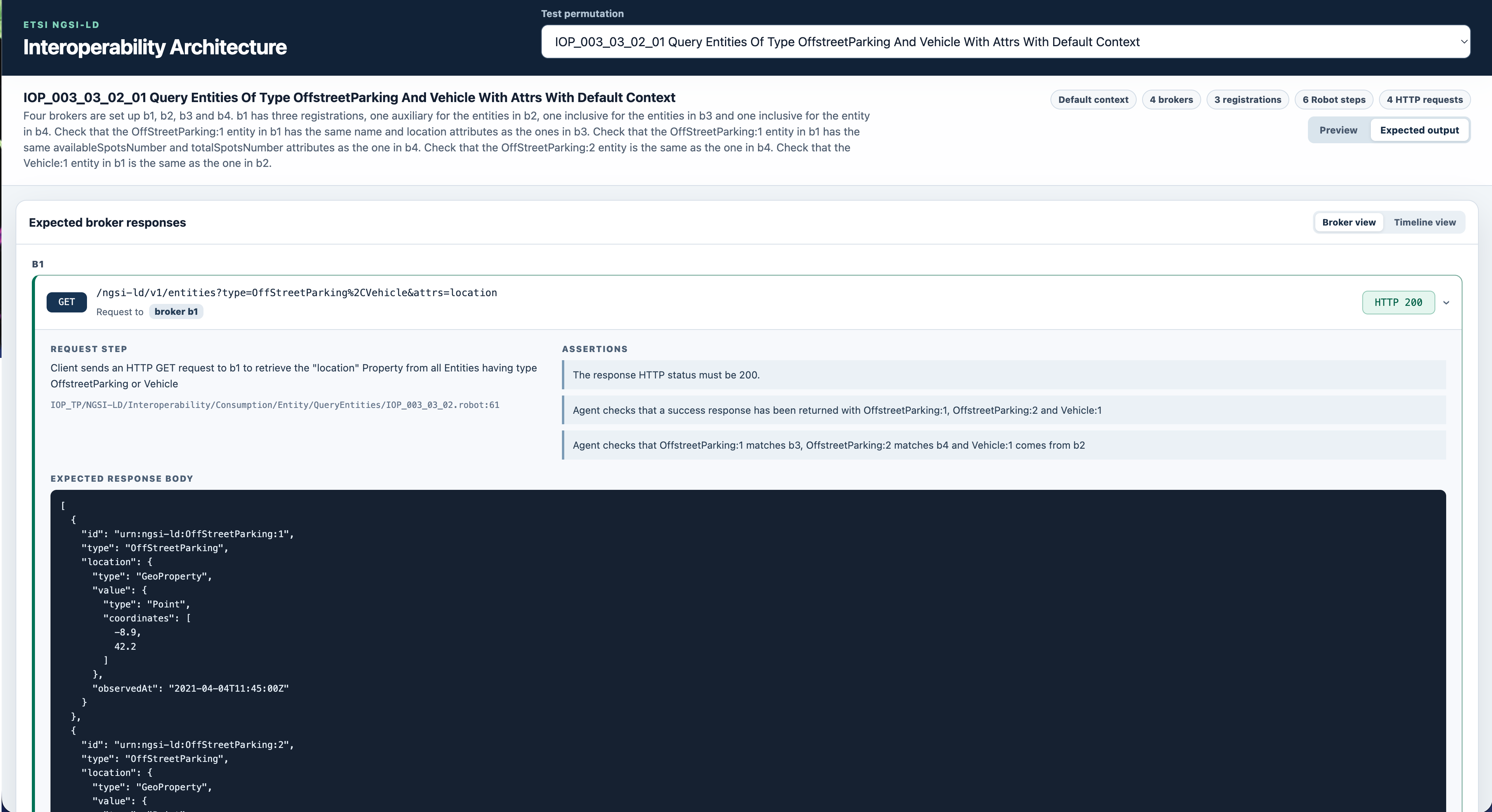
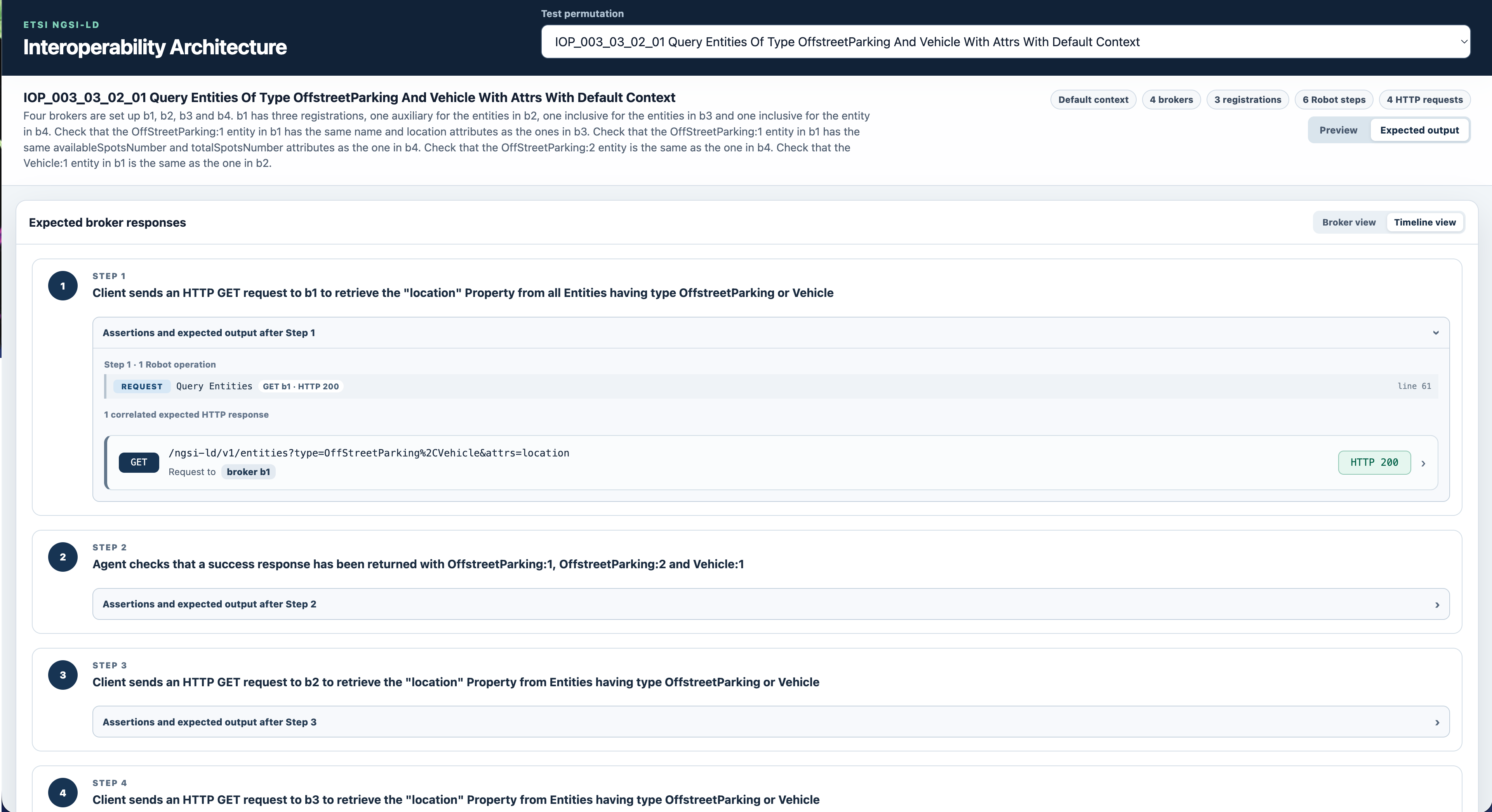
Graph is interactive, users can move the nodes, click on them (opens a more detailed panel on the side), and can also check on expected outputs grouped by broker (which are basically queries with local=true if they are not b1, or the query from b1) or steps (expected output for that step).

Screenshots:

Graph view:
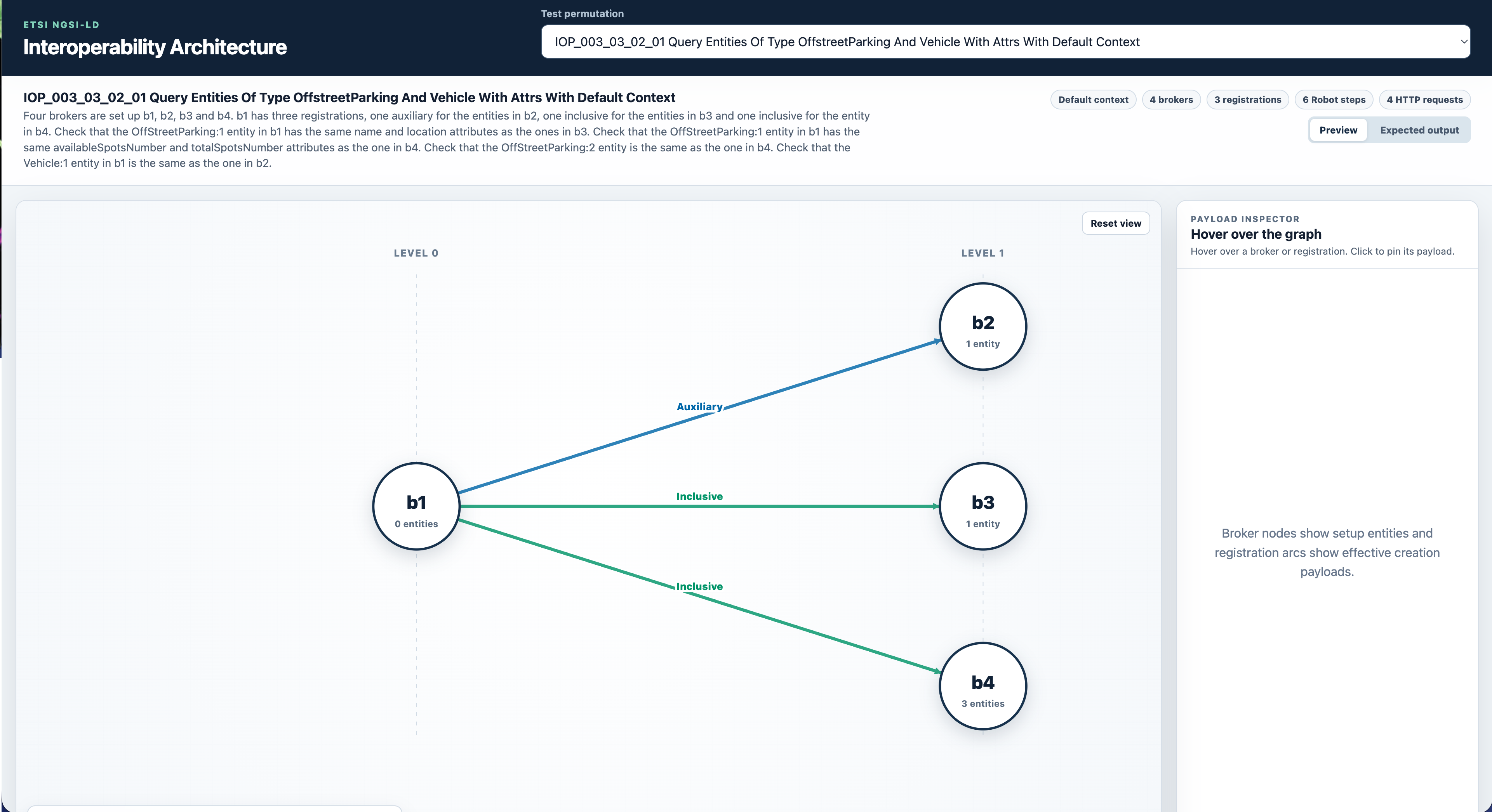
image

Hover/click on a node (broker) or edge (registration):
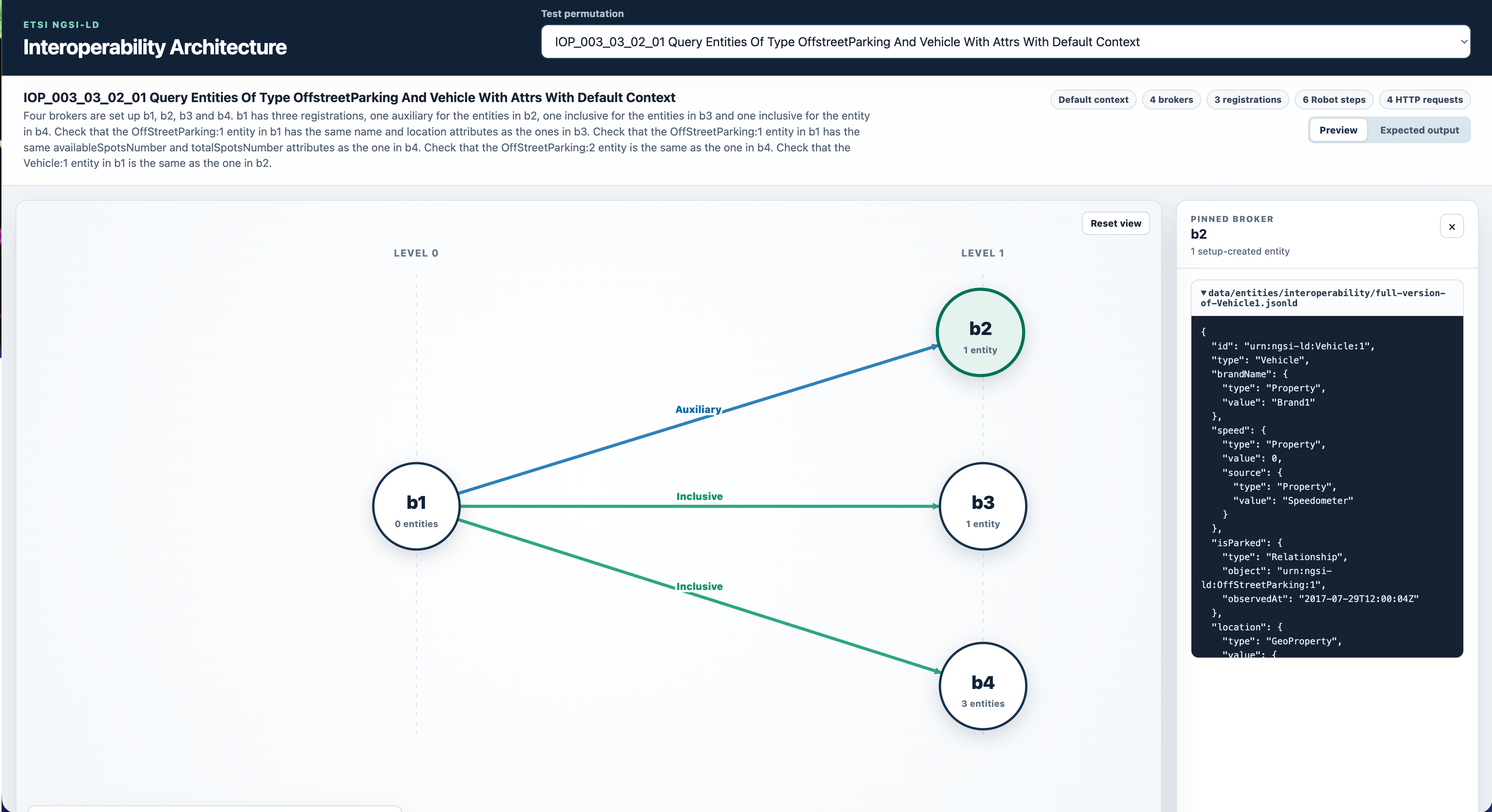
image

Expected outputs (per broker):

image

Expected outputs (for each step):

image

Expected output of one step:

image

Edited by Marco Cavalli

Merge request reports

Loading
+11 −0
Changes for doc/analysis/generaterobotdata.py: 11 added lines, 0 removed lines.
Original line number Diff line number Diff line
@@ -654,6 +654,7 @@ class GenerateRobotData:

        self.test_suite = {
            'tp_id': tp_id,
            'name': self.generate_iop_test_name(),
            'test_objective': self.suite.doc,
            'reference': reference,
            'config_id': str(),
@@ -670,6 +671,16 @@ class GenerateRobotData:
                test_name=self.robot.test_case_names[0]
            )

    def generate_iop_test_name(self) -> str:
        test_names = self.robot.test_case_names
        if len(test_names) == 1:
            return test_names[0]

        _, separator, name = test_names[0].partition(' ')
        name = name.replace(' With Default Context', '')
        name = name.replace(' With User Context', '')
        return f'{self.robot.test_suite}{separator}{name}'

    def _get_iop_setup(self, test_name: str):
        test = next((item for item in self.suite.tests if item.name == test_name), None)
        if test is None:
+32 −4
Changes for doc/tests/test_iop_preconditions.py: 32 added lines, 4 removed lines.
Original line number Diff line number Diff line
@@ -11,7 +11,13 @@ from analysis.generaterobotdata import GenerateRobotData


class IopPreconditionsTest(unittest.TestCase):
    def generate(self, variables: str, setup: str, test_body: str = '    No Operation'):
    def generate(
        self,
        variables: str,
        setup: str,
        test_body: str = '    No Operation',
        test_name: str = 'IOP_999_01 Generated Preconditions',
    ):
        robot = f'''*** Settings ***
Documentation       Objective
Test Setup          Prepare Preconditions
@@ -22,7 +28,7 @@ Test Setup Prepare Preconditions


*** Test Cases ***
IOP_999_01 Generated Preconditions
{test_name}
    [Documentation]    Pre-conditions: documentation must be ignored.
    [Tags]
    ...    since_v1.6.1
@@ -70,6 +76,20 @@ Prepare Preconditions
            ['since_v1.6.1', 'iop', '4_3_3']
        )

    def test_preserves_context_in_single_test_case_name(self):
        name = 'IOP_999_01 Scenario With Default Context'
        self.generate(
            variables='${b1_url}    ${EMPTY}',
            setup='    No Operation',
            test_name=name,
        )

        self.assertEqual(self.generated_info['name'], name)
        self.assertEqual(
            self.generated_info['test_cases'][0]['name'],
            name
        )

    def test_generates_mixed_context_and_data_objects(self):
        result = self.generate(
            variables='''${first_payload}     fixtures/first-entity.jsonld
@@ -181,12 +201,12 @@ ${b1_url} ${EMPTY}


*** Test Cases ***
IOP_999_01_01 Default Context
IOP_999_01_01 Scenario With Default Context
    [Tags]    since_v1.6.1    iop    4_3_3    default-context
    [Setup]    Prepare Preconditions    ${core_context}
    ${core_context}

IOP_999_01_02 User Context
IOP_999_01_02 Scenario With User Context
    [Tags]    since_v1.6.1    iop    4_3_3    user-context
    [Setup]    Prepare Preconditions    context=${ngsild_test_suite_context}
    ${ngsild_test_suite_context}
@@ -210,6 +230,14 @@ Prepare Preconditions
        user_conditions = self.generated_info['test_cases'][1]['initial_conditions']

        self.assertNotIn('initial_conditions', self.generated_info)
        self.assertEqual(self.generated_info['name'], 'IOP_999_01 Scenario')
        self.assertEqual(
            [test_case['name'] for test_case in self.generated_info['test_cases']],
            [
                'IOP_999_01_01 Scenario With Default Context',
                'IOP_999_01_02 Scenario With User Context',
            ]
        )
        self.assertEqual(
            default_conditions['pre_conditions'][0],
            {
+429 −0
Changes for tools/interoperability_visualizer/tests/test_visualizer.py: 429 added lines, 0 removed lines.
Original line number Diff line number Diff line
import argparse
import json
import re
import sys
import tempfile
import unittest
from pathlib import Path


ROOT = Path(__file__).resolve().parents[3]
TOOL_DIR = ROOT / "tools" / "interoperability_visualizer"
sys.path.insert(0, str(TOOL_DIR))

from extractor import ExtractionError, extract_source
from generate import DATA_TOKEN, render_viewer, validate_output_name


class Fixture:
    def __init__(self):
        self.temporary_directory = tempfile.TemporaryDirectory()
        self.root = Path(self.temporary_directory.name)
        self.robot_file = self.root / "IOP_TP" / "NGSI-LD" / "Interoperability" / "fixture.robot"
        self.entity_file = self.root / "data" / "entities" / "interoperability" / "entity.jsonld"
        self.inclusive_file = (
            self.root
            / "data"
            / "csourceRegistrations"
            / "interoperability"
            / "registration-inclusive.jsonld"
        )
        self.redirect_file = (
            self.root
            / "data"
            / "csourceRegistrations"
            / "interoperability"
            / "registration-redirect.jsonld"
        )
        variables_file = self.root / "resources" / "variables.py"
        variables_file.parent.mkdir(parents=True)
        variables_file.write_text(
            "core_context = 'https://example.test/core.jsonld'\n"
            "ngsild_test_suite_context = 'https://example.test/user.jsonld'\n",
            encoding="utf-8",
        )
        self.entity_file.parent.mkdir(parents=True)
        self.entity_file.write_text(
            json.dumps({"id": "urn:old", "type": "Vehicle", "speed": {"type": "Property", "value": 10}}),
            encoding="utf-8",
        )
        registration = {
            "id": "urn:old-registration",
            "type": "ContextSourceRegistration",
            "information": [{"entities": [{"type": "Vehicle"}]}],
            "mode": "inclusive",
            "endpoint": "xxx",
        }
        self.inclusive_file.parent.mkdir(parents=True)
        self.inclusive_file.write_text(json.dumps(registration), encoding="utf-8")
        registration["mode"] = "redirect"
        self.redirect_file.write_text(json.dumps(registration), encoding="utf-8")
        self.write_robot()

    def cleanup(self):
        self.temporary_directory.cleanup()

    def write_robot(
        self,
        entity_payload: str = "interoperability/entity.jsonld",
        first_mode: str = "inclusive",
        first_endpoint: str = "${b2_url}",
        first_registration: str = "${inclusive_registration}",
        scenario_body: str = "    No Operation",
    ):
        self.robot_file.parent.mkdir(parents=True, exist_ok=True)
        self.robot_file.write_text(
            f"""*** Settings ***
Documentation       Fixture objective
Test Template       Run Scenario


*** Variables ***
${{entity_payload}}            {entity_payload}
${{inclusive_registration}}    csourceRegistrations/interoperability/registration-inclusive.jsonld
${{redirect_registration}}     csourceRegistrations/interoperability/registration-redirect.jsonld
${{b1_url}}                    ${{EMPTY}}
${{b2_url}}                    ${{EMPTY}}


*** Test Cases ***
IOP_999_01_01 Default Context
    [Tags]    since_v1.6.1    iop    default-context    4_3_3
    [Setup]    Prepare Configuration    ${{core_context}}
    ${{core_context}}

IOP_999_01_02 User Context
    [Tags]    since_v1.6.1    iop    user-context    4_3_3
    [Setup]    Prepare Configuration    ${{ngsild_test_suite_context}}
    ${{ngsild_test_suite_context}}


*** Keywords ***
Run Scenario
    [Arguments]    ${{context}}
{scenario_body}

Prepare Configuration
    [Arguments]    ${{context}}
    Set Test Variable    ${{entity_id}}    urn:ngsi-ld:Vehicle:1
    Create Entity
    ...    ${{entity_payload}}
    ...    ${{entity_id}}
    ...    broker_url=${{b2_url}}
    ...    context=${{context}}
    @{{first_set}}=    Create List
    ...    ${{entity_id}}
    ...    {first_registration}
    ...    {first_mode}
    ...    {first_endpoint}
    ...    ${{b1_url}}
    @{{second_set}}=    Create List
    ...    ${{EMPTY}}
    ...    ${{redirect_registration}}
    ...    redirect
    ...    ${{b2_url}}
    ...    ${{b1_url}}
    @{{configuration}}=    Create List    ${{first_set}}    ${{second_set}}
    Compose IOP Configuration    ${{configuration}}    ld_context=${{context}}
""",
            encoding="utf-8",
        )


class ExtractorTest(unittest.TestCase):
    def setUp(self):
        self.fixture = Fixture()
        self.addCleanup(self.fixture.cleanup)

    def test_extracts_direction_parallel_modes_and_effective_payloads(self):
        data = extract_source(self.fixture.robot_file, self.fixture.root)

        self.assertEqual(len(data["tests"]), 2)
        default_test, user_test = data["tests"]
        self.assertEqual([broker["id"] for broker in default_test["brokers"]], ["b1", "b2"])
        self.assertEqual([registration["source"] for registration in default_test["registrations"]], ["b1", "b1"])
        self.assertEqual([registration["target"] for registration in default_test["registrations"]], ["b2", "b2"])
        self.assertEqual([registration["mode"] for registration in default_test["registrations"]], ["inclusive", "redirect"])

        b2 = next(broker for broker in default_test["brokers"] if broker["id"] == "b2")
        self.assertEqual(len(b2["entities"]), 1)
        self.assertEqual(b2["entities"][0]["payload"]["id"], "urn:ngsi-ld:Vehicle:1")
        self.assertEqual(b2["entities"][0]["payload"]["@context"], "https://example.test/core.jsonld")

        registration = default_test["registrations"][0]
        self.assertEqual(registration["payload"]["id"], "${registration_id1}")
        self.assertEqual(registration["payload"]["endpoint"], "${b2_url}")
        self.assertEqual(registration["payload"]["mode"], "inclusive")
        self.assertEqual(registration["payload"]["@context"], "https://example.test/core.jsonld")
        self.assertEqual(
            registration["payload"]["information"][0]["entities"][0]["id"],
            "urn:ngsi-ld:Vehicle:1",
        )
        self.assertEqual(user_test["context"], "https://example.test/user.jsonld")
        self.assertEqual(
            user_test["registrations"][0]["payload"]["@context"],
            "https://example.test/user.jsonld",
        )

    def test_rejects_unsafe_payload_path(self):
        self.fixture.write_robot(entity_payload="../../outside.json")
        with self.assertRaisesRegex(ExtractionError, "unsafe payload path"):
            extract_source(self.fixture.robot_file, self.fixture.root)

    def test_rejects_missing_payload(self):
        self.fixture.write_robot(entity_payload="interoperability/missing.jsonld")
        with self.assertRaisesRegex(ExtractionError, "payload does not exist"):
            extract_source(self.fixture.robot_file, self.fixture.root)

    def test_rejects_malformed_json(self):
        self.fixture.entity_file.write_text("{", encoding="utf-8")
        with self.assertRaisesRegex(ExtractionError, "invalid JSON payload"):
            extract_source(self.fixture.robot_file, self.fixture.root)

    def test_rejects_unsupported_mode(self):
        self.fixture.write_robot(first_mode="mystery")
        with self.assertRaisesRegex(ExtractionError, "unsupported registration mode 'mystery'"):
            extract_source(self.fixture.robot_file, self.fixture.root)

    def test_rejects_invalid_broker_variable(self):
        self.fixture.write_robot(first_endpoint="${peer_url}")
        with self.assertRaisesRegex(ExtractionError, "is not a broker variable"):
            extract_source(self.fixture.robot_file, self.fixture.root)


class ExpectedOutputsTest(unittest.TestCase):
    def setUp(self):
        self.fixture = Fixture()
        self.addCleanup(self.fixture.cleanup)

    def extract_test(self):
        return extract_source(self.fixture.robot_file, self.fixture.root)["tests"][0]

    def extract_steps(self):
        return self.extract_test()["steps"]

    def test_reconstructs_retrieve_body_endpoint_and_nested_comments(self):
        self.fixture.write_robot(
            scenario_body="""    # Client retrieves the Vehicle
    ${response}=    Retrieve Entity
    ...    ${entity_id}
    ...    attrs=speed
    ...    local=true
    ...    broker_url=${b2_url}
    ...    context=${context}
    ...    type=Vehicle
    # Agent checks the exact entity:
    # - only the speed attribute is returned
    Check Response Status Code    200    ${response.status_code}
    ${expected}=    Load Entity    ${entity_payload}    ${entity_id}
    Keep In Dictionary    ${expected}    id    type    speed
    Check Resource Set To    ${expected}    ${response.json()}"""
        )

        extracted = self.extract_test()
        step = extracted["steps"][0]
        self.assertEqual(step["method"], "GET")
        self.assertEqual(
            step["endpoint"],
            "/ngsi-ld/v1/entities/urn:ngsi-ld:Vehicle:1?type=Vehicle&attrs=speed&local=true",
        )
        self.assertEqual(step["broker"], "b2")
        self.assertEqual(step["status"], 200)
        self.assertEqual(step["resolution"], "exact")
        self.assertEqual(set(step["expected_body"]), {"id", "type", "speed"})
        self.assertEqual(step["request_comment"], "Client retrieves the Vehicle")
        self.assertIn("\n- only the speed attribute is returned", step["expectation_comments"][0])
        self.assertGreater(step["source_line"], 0)
        timeline = extracted["timeline_steps"]
        self.assertEqual(len(timeline), 2)
        self.assertEqual(timeline[0]["text"], "Client retrieves the Vehicle")
        self.assertEqual(
            timeline[1]["text"],
            "Agent checks the exact entity:\n- only the speed attribute is returned",
        )
        self.assertEqual(timeline[0]["request_ids"], ["step-1"])
        self.assertEqual(timeline[1]["request_ids"], ["step-1"])
        self.assertEqual([timeline_step["group"] for timeline_step in timeline], [1, 2])
        self.assertEqual(
            [operation["keyword"] for operation in timeline[1]["operations"]],
            ["Check Response Status Code", "Load Entity", "Keep In Dictionary", "Check Resource Set To"],
        )

    def test_resolves_post_query_and_cross_broker_payload_reference(self):
        self.fixture.write_robot(
            scenario_body="""    # Client queries b1 via POST
    &{selector}=    Create Dictionary    type=Vehicle
    @{selectors}=    Create List    ${selector}
    ${response_b1}=    Query Entities Via POST
    ...    entities=${selectors}
    ...    broker_url=${b1_url}
    ...    context=${context}
    # Agent checks b1
    Check Response Status Code    200    ${response_b1.status_code}
    ${ids_b1}=    Create List    ${entity_id}
    Check Response Body Containing Entities URIS set to    ${ids_b1}    ${response_b1.json()}
    ${entity_b1}=    Get Value From JSON    ${response_b1.json()}    $[?(@.id=='${entity_id}')]
    # Client queries b2
    ${response_b2}=    Query Entities
    ...    entity_types=Vehicle
    ...    broker_url=${b2_url}
    ...    context=${context}
    Check Response Status Code    200    ${response_b2.status_code}
    ${ids_b2}=    Create List    ${entity_id}
    Check Response Body Containing Entities URIS set to    ${ids_b2}    ${response_b2.json()}
    ${entity_b2}=    Get Value From JSON    ${response_b2.json()}    $[?(@.id=='${entity_id}')]
    ${expected_b2}=    Load Entity    ${entity_payload}    ${entity_id}
    Check Resource Set To    ${expected_b2}    ${entity_b2}[0]
    # Agent checks b1 combines b2
    ${expected_b1}=    Load Entity    ${entity_payload}    ${entity_id}
    Keep In Dictionary    ${expected_b1}    id    type
    Set To Dictionary    ${expected_b1}    speed=${entity_b2}[0][speed]
    Check Resource Set To    ${expected_b1}    ${entity_b1}[0]"""
        )

        first, second = self.extract_steps()
        self.assertEqual(first["endpoint"], "/ngsi-ld/v1/entityOperations/query")
        self.assertEqual(first["request_comment"], "Client queries b1 via POST")
        self.assertEqual(first["resolution"], "exact")
        self.assertEqual(first["expected_body"][0]["speed"], second["expected_body"][0]["speed"])
        self.assertEqual(second["endpoint"], "/ngsi-ld/v1/entities?type=Vehicle")

    def test_creation_and_not_found_are_status_only(self):
        self.fixture.write_robot(
            scenario_body="""    # Client creates an entity
    ${response}=    Create Entity
    ...    ${entity_payload}
    ...    ${entity_id}
    ...    broker_url=${b1_url}
    ...    context=${context}
    Check Response Status Code    201    ${response.status_code}
    # Client retrieves a missing entity
    ${response}=    Retrieve Entity
    ...    urn:ngsi-ld:Vehicle:missing
    ...    broker_url=${b1_url}
    ...    context=${context}
    Check Response Status Code    404    ${response.status_code}"""
        )

        steps = self.extract_steps()
        self.assertEqual([step["status"] for step in steps], [201, 404])
        self.assertTrue(all(step["expected_body"] is None for step in steps))
        self.assertTrue(all(step["resolution"] == "status-only" for step in steps))

    def test_unsupported_body_expression_remains_unresolved(self):
        self.fixture.write_robot(
            scenario_body="""    # Client retrieves an entity
    ${response}=    Retrieve Entity
    ...    ${entity_id}
    ...    broker_url=${b1_url}
    Check Response Status Code    200    ${response.status_code}
    Check Resource Set To    ${unsupported_expression}    ${response.json()}"""
        )

        step = self.extract_steps()[0]
        self.assertEqual(step["status"], 200)
        self.assertEqual(step["resolution"], "unresolved")
        self.assertIsNone(step["expected_body"])


class GeneratorTest(unittest.TestCase):
    def test_output_name_rejects_paths_and_non_html_files(self):
        for value in ("../viewer.html", "folder/viewer.html", "folder\\viewer.html", "viewer.json", ""):
            with self.subTest(value=value):
                with self.assertRaises(argparse.ArgumentTypeError):
                    validate_output_name(value)
        self.assertEqual(validate_output_name("viewer.html"), "viewer.html")

    def test_render_viewer_escapes_embedded_markup(self):
        rendered = render_viewer({"value": "</script><script src='x'>&"}, f"<script>{DATA_TOKEN}</script>")
        self.assertNotIn("</script><script src", rendered)
        self.assertIn("\\u003c/script\\u003e", rendered)
        self.assertIn("\\u0026", rendered)

    def test_template_is_offline_and_contains_the_legend(self):
        template = (TOOL_DIR / "viewer_template.html").read_text(encoding="utf-8")
        self.assertIsNone(re.search(r"(?:src|href)\s*=\s*['\"]https?://", template, re.IGNORECASE))
        for label, color in (
            ("Inclusive", "#009E73"),
            ("Auxiliary", "#0072B2"),
            ("Redirect", "#E69F00"),
            ("Exclusive", "#CC79A7"),
        ):
            self.assertIn(label, template)
            self.assertIn(color, template)
        for value in (
            "Expected broker responses",
            ">Preview</button>",
            ">Expected output</button>",
            "Broker view",
            "Timeline view",
            "view-expectations",
            'setSurfaceView("expectations")',
            "response-step",
            "response-expanded",
            "response-hierarchy",
            "status-code",
            "responseItem(step)",
            "timeline-step",
            "timelineGroup(steps, requestsById)",
            "Assertions and expected output after Step",
            "Robot operation",
            "correlated expected HTTP response",
            "level-guide",
            "initialPositions(test)",
            "levels.set(target, nextLevel)",
            "renderLevels()",
        ):
            self.assertIn(value, template)

    def test_output_directory_is_git_ignored(self):
        gitignore = (ROOT / ".gitignore").read_text(encoding="utf-8").splitlines()
        self.assertIn("/tools/interoperability_visualizer/output/", gitignore)


class CorpusIntegrationTest(unittest.TestCase):
    def test_extracts_complete_interoperability_corpus(self):
        data = extract_source(ROOT / "IOP_TP" / "NGSI-LD" / "Interoperability", ROOT)
        tests = data["tests"]
        suites = {test["suite"] for test in tests}
        first_per_suite = {test["suite"]: test for test in tests}

        self.assertEqual(len(suites), 24)
        self.assertEqual(len(tests), 48)
        self.assertEqual(sum(len(test["registrations"]) for test in first_per_suite.values()), 82)
        steps = [step for test in first_per_suite.values() for step in test["steps"]]
        all_steps = [step for test in tests for step in test["steps"]]
        timeline_steps = [step for test in first_per_suite.values() for step in test["timeline_steps"]]
        all_timeline_steps = [step for test in tests for step in test["timeline_steps"]]
        self.assertEqual(len(steps), 91)
        self.assertEqual(len(all_steps), 182)
        self.assertEqual(len(timeline_steps), 133)
        self.assertEqual(len(all_timeline_steps), 266)
        self.assertTrue(all(step["text"] and step["operations"] for step in timeline_steps))
        self.assertTrue(all(step["request_ids"] for step in timeline_steps))
        grouped_example = next(
            test
            for test in tests
            if test["suite"].endswith("RetrieveEntity/IOP_002_04_02.robot")
        )
        self.assertEqual(
            [step["group"] for step in grouped_example["timeline_steps"]],
            [1, 2, 3, 4, 5, 6],
        )
        self.assertEqual(
            {status: sum(step["status"] == status for step in steps) for status in (200, 201, 404)},
            {200: 74, 201: 8, 404: 9},
        )
        self.assertTrue(all(step["resolution"] == "exact" for step in steps if step["status"] == 200))
        for step in steps:
            if isinstance(step["expected_body"], list):
                ids = [entity["id"] for entity in step["expected_body"]]
                self.assertEqual(ids, sorted(ids))
        self.assertEqual(
            {registration["mode"] for test in tests for registration in test["registrations"]},
            {"inclusive", "auxiliary", "redirect", "exclusive"},
        )


if __name__ == "__main__":
    unittest.main()
+70 −0
Changes for tools/interoperability_visualizer/README.md: 70 added lines, 0 removed lines.
Original line number Diff line number Diff line
# Interoperability Architecture Visualizer

Generates an offline interactive architecture view of the Robot Framework tests in
`IOP_TP/NGSI-LD/Interoperability`.

## Run

With the project environment active:

```console
python tools/interoperability_visualizer/generate.py
```

Using the local `ttf3` Conda environment:

```console
conda run -n ttf3 python tools/interoperability_visualizer/generate.py
```

The generated page is written to:

```text
tools/interoperability_visualizer/output/interoperability-architecture.html
```

Select a different Robot file or directory with `--source`:

```console
python tools/interoperability_visualizer/generate.py \
  --source IOP_TP/NGSI-LD/Interoperability/Provision/CreateEntity
```

Select another filename inside the dedicated output directory with `--output-name`:

```console
python tools/interoperability_visualizer/generate.py --output-name provision.html
```

Output paths and non-HTML output names are rejected. The complete `output/` directory is ignored by Git.

## Viewer

- Select any concrete interoperability test permutation.
- Switch between the full-size **Preview** graph and **Expected output** workspace.
- Brokers use a left-to-right hierarchy rooted at `b1`; each registration hop advances one level.
- Hover over a broker to inspect every entity created in that broker during setup.
- Hover over a registration arc to inspect its effective creation payload.
- Browse assertion-derived expected responses by broker or in execution order.
- Timeline view treats each consecutive inline comment block as one numbered Robot step and nests every correlated
  Robot keyword operation and expected HTTP response below it.
- Every numbered comment step has its own assertion panel, including `Client sends` and `Agent checks` steps.
- Expand a response step to see its prominent HTTP status, request, assertions, and expected JSON inline.
- Click a broker or registration to pin it; press Escape or use the close button to unpin it.
- Drag brokers to rearrange the architecture.
- Drag empty graph space to pan, use the mouse wheel to zoom, and use **Reset view** to restore the hierarchy and viewport.

Registration arrows start at the broker where the registration is created and point to the broker referenced by its
endpoint. Effective payloads resolve entity IDs and contexts while keeping runtime broker URLs and generated
registration IDs symbolic.

Expected responses are derived statically from the Robot request and assertion calls. HTTP 201 and 404 steps remain
status-only, and unsupported future assertion patterns are displayed as unresolved instead of inventing a body.

## Test

```console
conda run -n ttf3 python -m unittest discover \
  -s tools/interoperability_visualizer/tests \
  -p 'test_*.py'
```
+554 −0
Changes for tools/interoperability_visualizer/expected_outputs.py: 554 added lines, 0 removed lines.
Original line number Diff line number Diff line
import copy
import re
from dataclasses import dataclass
from pathlib import Path
from urllib.parse import quote, urlencode

from robot.api import get_model

from extractor import (
    ExtractionError,
    _broker_name,
    _call_arguments,
    _load_payload,
    _payload_path,
)


REQUESTS = {
    "Create Entity": ("POST", "/ngsi-ld/v1/entities"),
    "Retrieve Entity": ("GET", "/ngsi-ld/v1/entities/{id}"),
    "Query Entities": ("GET", "/ngsi-ld/v1/entities"),
    "Query Entities Via POST": ("POST", "/ngsi-ld/v1/entityOperations/query"),
}
SIGNATURES = {
    "Create Entity": ("filename", "entity_id", "local", "broker_url", "context"),
    "Retrieve Entity": (
        "id", "accept", "attrs", "context", "geometryProperty", "options", "format", "lang",
        "join", "joinLevel", "pick", "omit", "local", "broker_url", "type",
    ),
    "Query Entities": (
        "entity_ids", "entity_types", "accept", "attrs", "context", "geoproperty", "options",
        "limit", "entity_id_pattern", "scopeq", "georel", "coordinates", "geometry", "count",
        "q", "local", "datasetId", "join", "joinLevel", "pick", "omit", "orderBy", "broker_url",
    ),
    "Query Entities Via POST": (
        "entities", "content_type", "accept", "context", "attrs", "geometry_property", "join",
        "joinLevel", "local", "options", "broker_url",
    ),
}
VARIABLE = re.compile(r"^[$@&]\{([^}]+)\}(.*)$")
VARIABLE_ANYWHERE = re.compile(r"[$@&]\{([^}]+)\}")
PATH_PART = re.compile(r"\[([^]]+)\]")
JSON_ENTITY_ID = re.compile(r"@\.id\s*==\s*['\"]([^'\"]+)['\"]")


@dataclass(frozen=True)
class Response:
    request_id: str


@dataclass(frozen=True)
class Ref:
    request_id: str
    path: tuple = ()


@dataclass(frozen=True)
class Unknown:
    expression: str


def extract_expected_steps(
    robot_file: Path,
    suite,
    test,
    setup_env: dict,
    root: Path,
    relative_robot_file: str,
) -> tuple[list[dict], list[dict]]:
    execution = next((keyword for keyword in suite.resource.keywords if keyword.name == test.template), None)
    if execution is None:
        raise ExtractionError(
            f"{relative_robot_file}: template keyword '{test.template}' for '{test.name}' was not found"
        )

    model = get_model(str(robot_file))
    parsed = _parsed_keyword(model, str(test.template))
    if parsed is None:
        raise ExtractionError(
            f"{relative_robot_file}: parsed template keyword '{test.template}' for '{test.name}' was not found"
        )

    env = _initial_environment(setup_env)
    env.update(_template_variables(test, execution))
    evaluator = Evaluator(env, root, relative_robot_file, test.name)
    evaluator.process(parsed.body)
    return evaluator.finish(), evaluator.finish_timeline()


class Evaluator:
    def __init__(self, env: dict, root: Path, robot_file: str, test_name: str):
        self.env = env
        self.root = root
        self.robot_file = robot_file
        self.test_name = test_name
        self.requests = []
        self.by_id = {}
        self.bindings = {}
        self.comment = ""
        self.timeline_steps = []
        self.current_timeline = None

    def process(self, body) -> None:
        index = 0
        while index < len(body):
            item = body[index]
            if type(item).__name__ == "Comment":
                comments = []
                source_line = int(item.lineno)
                while index < len(body) and type(body[index]).__name__ == "Comment":
                    comments.append(_comment_text(body[index]))
                    index += 1
                self.comment = "\n".join(comment for comment in comments if comment)
                self.current_timeline = {
                    "id": f"timeline-step-{len(self.timeline_steps) + 1}",
                    "order": len(self.timeline_steps) + 1,
                    "text": self.comment,
                    "source_line": source_line,
                    "operations": [],
                    "request_ids": [],
                }
                self.timeline_steps.append(self.current_timeline)
                continue
            if type(item).__name__ == "KeywordCall":
                name = str(item.keyword)
                args = tuple(str(arg) for arg in item.args)
                request_ids = self._request_ids(args)
                request_count = len(self.requests)
                self._call(name, args, item.assign, item.lineno)
                if len(self.requests) > request_count:
                    request_ids.append(self.requests[-1]["id"])
                self._timeline_operation(name, item.lineno, request_ids)
            index += 1

    def _timeline_operation(self, name: str, source_line: int, request_ids: list[str]) -> None:
        if self.current_timeline is None:
            return
        unique_ids = list(dict.fromkeys(request_ids))
        if name in REQUESTS:
            kind = "request"
        elif name.startswith("Check "):
            kind = "assertion"
        else:
            kind = "preparation"
        self.current_timeline["operations"].append(
            {
                "id": f"{self.current_timeline['id']}-operation-{len(self.current_timeline['operations']) + 1}",
                "order": len(self.current_timeline["operations"]) + 1,
                "keyword": name,
                "kind": kind,
                "source_line": int(source_line),
                "request_ids": unique_ids,
            }
        )
        for request_id in unique_ids:
            if request_id not in self.current_timeline["request_ids"]:
                self.current_timeline["request_ids"].append(request_id)

    def _request_ids(self, expressions: tuple[str, ...]) -> list[str]:
        request_ids = []
        for expression in expressions:
            key, separator, value = expression.partition("=")
            target = value if separator and re.match(r"^[A-Za-z_][A-Za-z0-9_-]*$", key) else expression
            request_ids.extend(_request_ids_in_value(self.value(target)))
        return list(dict.fromkeys(request_ids))

    def _call(self, name: str, args: tuple[str, ...], assign, lineno: int) -> None:
        if name in REQUESTS:
            self._request(name, args, assign, lineno)
        elif name == "Load Entity":
            self._load_entity(args, assign)
        elif name == "Create List":
            self._assign(assign, [self.value(arg) for arg in args])
        elif name == "Create Dictionary":
            self._assign(assign, self._dictionary(args))
        elif name == "Remove From Dictionary" and args:
            target = self.value(args[0])
            if isinstance(target, dict):
                for key in args[1:]:
                    target.pop(str(self.value(key)), None)
        elif name == "Keep In Dictionary" and args:
            target = self.value(args[0])
            if isinstance(target, dict):
                keys = {str(self.value(key)) for key in args[1:]}
                for key in tuple(target):
                    if key not in keys:
                        del target[key]
        elif name == "Set To Dictionary" and args:
            target = self.value(args[0])
            if isinstance(target, dict):
                target.update(self._dictionary(args[1:]))
        elif name == "Get Value From JSON" and len(args) >= 2:
            self._select_json_entity(args, assign)
        elif name == "Check Response Status Code" and len(args) >= 2:
            request = self._request_from(args[1])
            if request:
                status = self.value(args[0])
                try:
                    request["status"] = int(status)
                except (TypeError, ValueError):
                    request["status"] = None
                self._expectation(request)
        elif name == "Check Response Body Containing Entities URIS set to" and len(args) >= 2:
            request = self._request_from(args[1])
            if request:
                ids = self.value(args[0])
                request["expected_ids"] = ids if isinstance(ids, list) else Unknown(args[0])
                self._expectation(request)
        elif name == "Check Resource Set To" and len(args) >= 2:
            self._resource_equality(args[0], args[1])

    def _request(self, name: str, args: tuple[str, ...], assign, lineno: int) -> None:
        values = _call_arguments(args, SIGNATURES[name], name)
        if "broker_url" not in values:
            raise ExtractionError(f"{self.robot_file}: {name} lacks broker_url in '{self.test_name}'")
        broker = _broker_name(
            values["broker_url"],
            _broker_environment(self.env),
            f"{self.robot_file}: {name} broker in '{self.test_name}'",
        )
        request_id = f"step-{len(self.requests) + 1}"
        method, base_endpoint = REQUESTS[name]
        endpoint = self._endpoint(name, base_endpoint, values)
        request = {
            "id": request_id,
            "order": len(self.requests) + 1,
            "method": method,
            "endpoint": endpoint,
            "broker": broker,
            "status": None,
            "request_comment": self.comment,
            "expectation_comments": [],
            "expected_body": None,
            "resolution": "unresolved",
            "source_line": int(lineno),
            "operation": name,
            "expected_ids": None,
        }
        self.requests.append(request)
        self.by_id[request_id] = request
        self._assign(assign, Response(request_id))

    def _endpoint(self, name: str, base_endpoint: str, values: dict[str, str]) -> str:
        if name == "Retrieve Entity":
            entity_id = self.value(values.get("id", ""))
            if isinstance(entity_id, Unknown):
                entity_id = values.get("id", "")
            base_endpoint = base_endpoint.format(id=quote(str(entity_id), safe=":-._~"))
        params = []
        type_value = values.get("type") if name == "Retrieve Entity" else values.get("entity_types")
        for label, raw in (("type", type_value), ("attrs", values.get("attrs")), ("local", values.get("local"))):
            if raw is None:
                continue
            value = self.value(raw)
            if not isinstance(value, Unknown) and value != "":
                params.append((label, str(value)))
        return f"{base_endpoint}?{urlencode(params)}" if params else base_endpoint

    def _load_entity(self, args: tuple[str, ...], assign) -> None:
        if len(args) < 2:
            self._assign(assign, Unknown("Load Entity"))
            return
        filename = self.value(args[0])
        entity_id = self.value(args[1])
        if isinstance(filename, Unknown) or isinstance(entity_id, Unknown):
            self._assign(assign, Unknown("Load Entity"))
            return
        path = _payload_path(self.root / "data" / "entities", str(filename), self.root, self.robot_file)
        payload = _load_payload(path, self.robot_file)
        payload["id"] = entity_id
        self._assign(assign, payload)

    def _select_json_entity(self, args: tuple[str, ...], assign) -> None:
        request = self._request_from(args[0])
        path = self.value(args[1])
        if not request or isinstance(path, Unknown):
            self._assign(assign, Unknown(args[1]))
            return
        match = JSON_ENTITY_ID.search(str(path))
        if match is None:
            self._assign(assign, Unknown(args[1]))
            return
        self._assign(assign, [Ref(request["id"], ("entity", match.group(1)))])

    def _resource_equality(self, expected_expression: str, actual_expression: str) -> None:
        expected = self.value(expected_expression)
        actual = self.value(actual_expression)
        request = self._request_from(actual_expression) or self._request_from(expected_expression)
        if request:
            self._expectation(request)
        if isinstance(actual, Ref):
            self.bindings[actual] = copy.deepcopy(expected)
        elif isinstance(expected, Ref):
            self.bindings[expected] = copy.deepcopy(actual)

    def _dictionary(self, args: tuple[str, ...]) -> dict:
        result = {}
        positional = []
        for arg in args:
            key, separator, value = arg.partition("=")
            if separator:
                result[key] = self.value(value)
            else:
                positional.append(self.value(arg))
        for index in range(0, len(positional) - 1, 2):
            result[str(positional[index])] = positional[index + 1]
        return result

    def _expectation(self, request: dict) -> None:
        if not self.comment:
            return
        if self.comment != request["request_comment"] or self.comment.lstrip().lower().startswith("agent"):
            if self.comment not in request["expectation_comments"]:
                request["expectation_comments"].append(self.comment)

    def _request_from(self, expression: str):
        value = self.value(expression)
        if isinstance(value, Response):
            return self.by_id.get(value.request_id)
        if isinstance(value, Ref):
            return self.by_id.get(value.request_id)
        return None

    def _assign(self, assign, value) -> None:
        if not assign:
            return
        name = _variable_name(str(assign[0]).rstrip("="))
        if name:
            self.env[name] = value

    def value(self, expression: str, seen: set[str] | None = None):
        raw = str(expression)
        match = VARIABLE.match(raw)
        if match:
            name, suffix = match.groups()
            response_part = None
            if name.endswith(".json()"):
                response_part = "body"
                name = name[:-7]
            elif name.endswith(".status_code"):
                response_part = "status"
                name = name[:-12]
            if name in self.env:
                if seen is None:
                    seen = set()
                if name in seen:
                    return Unknown(raw)
                seen = {*seen, name}
                value = self.env[name]
                if isinstance(value, str) and VARIABLE.match(value):
                    value = self.value(value, seen)
                if response_part == "body" and isinstance(value, Response):
                    value = Ref(value.request_id)
                elif response_part == "status" and isinstance(value, Response):
                    return value
                elif response_part is not None:
                    return Unknown(raw)
                return _apply_suffix(value, suffix, raw)
            if not suffix:
                return Unknown(raw)

        unknown = False

        def replace(variable_match):
            nonlocal unknown
            name = variable_match.group(1)
            if name not in self.env:
                unknown = True
                return variable_match.group(0)
            value = self.env[name]
            if isinstance(value, str) and VARIABLE.match(value):
                value = self.value(value)
            if isinstance(value, (dict, list, Ref, Response, Unknown)):
                unknown = True
                return variable_match.group(0)
            return str(value)

        resolved = VARIABLE_ANYWHERE.sub(replace, raw)
        return Unknown(raw) if unknown else resolved

    def finish(self) -> list[dict]:
        result = []
        for request in self.requests:
            status = request["status"]
            body = None
            resolution = "unresolved"
            if status == 200:
                if request["operation"].startswith("Query Entities"):
                    ids = self.resolve(request["expected_ids"])
                    if isinstance(ids, list) and all(not isinstance(item, Unknown) for item in ids):
                        bodies = [self.resolve(Ref(request["id"], ("entity", str(entity_id)))) for entity_id in ids]
                        if all(_is_concrete(item) for item in bodies):
                            body = sorted(bodies, key=lambda item: str(item.get("id", "")))
                            resolution = "exact"
                else:
                    candidate = self.resolve(Ref(request["id"]))
                    if _is_concrete(candidate):
                        body = candidate
                        resolution = "exact"
            elif status is not None:
                resolution = "status-only"

            result.append(
                {
                    "id": request["id"],
                    "order": request["order"],
                    "method": request["method"],
                    "endpoint": request["endpoint"],
                    "broker": request["broker"],
                    "status": status,
                    "request_comment": request["request_comment"],
                    "expectation_comments": request["expectation_comments"],
                    "expected_body": body,
                    "resolution": resolution,
                    "source_line": request["source_line"],
                }
            )
        return result

    def finish_timeline(self) -> list[dict]:
        timeline = copy.deepcopy(self.timeline_steps)
        for step in timeline:
            step["group"] = step["order"]
        return timeline

    def resolve(self, value, trail: set[Ref] | None = None):
        if isinstance(value, Unknown):
            return value
        if isinstance(value, Ref):
            if trail is None:
                trail = set()
            if value in trail:
                return Unknown(str(value))
            trail = {*trail, value}
            if value in self.bindings:
                return self.resolve(self.bindings[value], trail)
            for length in range(len(value.path) - 1, -1, -1):
                parent = Ref(value.request_id, value.path[:length])
                if parent not in self.bindings:
                    continue
                resolved = self.resolve(self.bindings[parent], trail)
                return _apply_path(resolved, value.path[length:], str(value))
            return Unknown(str(value))
        if isinstance(value, dict):
            return {key: self.resolve(item, trail) for key, item in value.items()}
        if isinstance(value, list):
            return [self.resolve(item, trail) for item in value]
        return value


def _parsed_keyword(model, name: str):
    for section in model.sections:
        if type(section).__name__ != "KeywordSection":
            continue
        for keyword in section.body:
            if str(keyword.name) == name:
                return keyword
    return None


def _template_variables(test, keyword) -> dict:
    if not test.body:
        return {}
    call = test.body[0]
    positional = []
    named = []
    names = set(keyword.args.argument_names)
    for argument in (str(item) for item in call.args):
        name, separator, value = argument.partition("=")
        if separator and name in names:
            named.append((name, value))
        else:
            positional.append(argument)
    try:
        mapped_positional, mapped_named = keyword.args.map(positional, named)
    except Exception as error:
        raise ExtractionError(f"Unable to map template arguments for '{test.name}': {error}") from error
    values = {name: str(value) for name, value in zip(keyword.args.positional, mapped_positional)}
    values.update((name, str(value)) for name, value in mapped_named)
    for name, value in keyword.args.defaults.items():
        values.setdefault(name, str(value))
    return values


def _initial_environment(env: dict) -> dict:
    result = {}
    for key, value in env.items():
        name = _variable_name(str(key))
        if name:
            result[name] = copy.deepcopy(value)
    return result


def _broker_environment(env: dict) -> dict:
    return {f"${{{name}}}": value for name, value in env.items() if isinstance(value, str)}


def _variable_name(value: str) -> str | None:
    match = re.match(r"^[$@&]\{([^}]+)\}$", value)
    return match.group(1) if match else None


def _comment_text(comment) -> str:
    token = next((token for token in comment.tokens if token.type == "COMMENT"), None)
    return token.value.lstrip("#").strip() if token else ""


def _apply_suffix(value, suffix: str, expression: str):
    if not suffix:
        return value
    parts = PATH_PART.findall(suffix)
    if "".join(f"[{part}]" for part in parts) != suffix:
        return Unknown(expression)
    if isinstance(value, Ref):
        return Ref(value.request_id, value.path + tuple(_path_key(part) for part in parts))
    return _apply_path(value, tuple(_path_key(part) for part in parts), expression)


def _apply_path(value, path: tuple, expression: str):
    current = value
    for index, key in enumerate(path):
        if isinstance(current, Unknown):
            return current
        if isinstance(current, Ref):
            return Ref(current.request_id, current.path + path[index:])
        try:
            current = current[key]
        except (KeyError, IndexError, TypeError):
            return Unknown(expression)
    return current


def _path_key(value: str):
    return int(value) if value.isdigit() else value


def _is_concrete(value) -> bool:
    if isinstance(value, (Unknown, Ref, Response)):
        return False
    if isinstance(value, dict):
        return all(_is_concrete(item) for item in value.values())
    if isinstance(value, list):
        return all(_is_concrete(item) for item in value)
    return True


def _request_ids_in_value(value) -> list[str]:
    if isinstance(value, (Response, Ref)):
        return [value.request_id]
    if isinstance(value, dict):
        return [request_id for item in value.values() for request_id in _request_ids_in_value(item)]
    if isinstance(value, (list, tuple)):
        return [request_id for item in value for request_id in _request_ids_in_value(item)]
    return []
Loading
Loading